
Abstract Paintings - Page 1
Abstract painting creates meaning through relationships among color, line, shape, space, and surface, using forms that may transform visible things or develop without an identifiable subject in the outside world. It encompasses several movements and methods, from geometric construction to fluid gestures and expansive fields of color. Some paintings preserve traces of a landscape, a figure, or a remembered sensation; others organize their elements without recognizable objects. As a category, abstraction describes an approach to making images that can extend across traditional genres.
Composition gives these works their particular character. A diagonal can interrupt the stability of a horizontal band; a small, dense shape can counterbalance a broad, lightly painted area. Sharp edges establish clear divisions, while softened boundaries allow adjacent colors to appear to mingle. Repetition introduces rhythm, and an unexpected interval can disturb it. The thickness of paint, the visibility of the canvas, and the proportions of the whole surface contribute as directly to the image as any individual mark.
The emergence of modern abstract painting drew on changes already underway in the late nineteenth century. Paul Cézanne built pictorial structure through relationships between colored planes. The Fauves subsequently expanded the expressive independence of color, while Cubism fragmented familiar objects and reorganized them across the picture surface. These experiments gave painters new ways to reconsider representation. A tree, a face, or a tabletop could become the starting point for an arrangement whose visual relationships acquired an increasingly independent importance.
Several artists pursued abstraction along distinct paths in the early twentieth century. Beginning in 1906, the Swedish painter Hilma af Klint developed works linked to her spiritual investigations, combining geometric and organic forms in cycles that remained largely outside public artistic debate during her lifetime. In the early 1910s, František Kupka and Robert and Sonia Delaunay explored the possibilities of color, light, and rhythm. Their differing interests show how abstraction emerged through overlapping experiments, with spiritual inquiry, theories of perception, and musical analogies providing different frameworks.
For Wassily Kandinsky, music offered an important model for relationships between visual elements and inner experience. In “Composition 8” (1923), in the Solomon R. Guggenheim Museum, New York, circles, diagonals, arcs, and angular shapes occupy a pale ground. Their uneven distribution creates passages of concentration and openness, while differences in size prevent the repeated forms from settling into a uniform pattern. Painted during his Bauhaus years, the work combines a clearly articulated geometric vocabulary with a restless composition. Its movement develops through the exchange between individual shapes and the larger arrangement.
Kazimir Malevich explored the implications of extreme reduction within Suprematism. His “Suprematist Composition: White on White” (1918), in the Museum of Modern Art, New York, places a tilted white square against a white ground. The distinction between the two depends on slight differences of tone, the handling of the paint, and the square’s orientation. Looking closely brings the surface and its irregularities into focus; from farther away, the displaced shape unsettles the surrounding field. Malevich associated white with infinity, giving this restricted pictorial language an explicitly utopian and spiritual dimension.
Piet Mondrian developed another influential geometric language through horizontal and vertical relationships and a restricted palette, closely associated with De Stijl. In “Broadway Boogie Woogie” (1942-1943), in the Museum of Modern Art, New York, the grid becomes a lively network of colored intervals. Small red, blue, and gray units punctuate yellow bands, creating changes of pace across the square canvas. The title connects the painting to Manhattan and to the music Mondrian enjoyed. Its abstract organization turns those experiences into visual rhythm: the eye follows a route, meets an interruption, and shifts direction through the interplay of continuous bands and separate blocks.
During the 1940s and 1950s, Abstract Expressionism brought new attention to the scale and physical process of painting in New York. Jackson Pollock’s “Autumn Rhythm (Number 30)” (1950), in the Metropolitan Museum of Art, spreads an intricate web of paint across a broad canvas. Working with the canvas on the floor, Pollock poured, dripped, and directed fluid paint from above. Overlapping strands establish varying densities, with areas of exposed canvas participating in the overall structure. The painting preserves successive actions and changes of direction. Its apparent freedom depends on decisions about spacing, accumulation, and the moment at which a passage has received enough paint.
Mark Rothko explored the intensity of large, simplified color relationships. “Orange and Yellow” (1956), in the Buffalo AKG Art Museum, places broad rectangles of warm color in a vertical composition. Soft boundaries and thin layers make the fields seem to expand and recede, while their proportions determine how much space each color occupies in the viewer’s attention. The painting’s size gives these relationships a physical presence. Rothko invested such arrangements with emotional seriousness; their effect develops through sustained looking, as distinctions in luminosity, density, and the meeting of adjacent areas become increasingly apparent.
Other painters extended abstraction through different treatments of surface and perception. Helen Frankenthaler allowed diluted paint to soak into unprimed canvas, bringing color and fabric into close material contact. Agnes Martin worked with grids, delicate lines, and restrained tonal variations, making small differences visible within a measured structure. Bridget Riley used repeated forms and calculated contrasts to generate sensations of optical movement. Across these approaches, the painter’s activity could involve staining, drawing, adjusting intervals, or carefully repeating a shape. A restrained surface might require as much sustained decision-making as a canvas filled with vigorous marks.
Viewing abstract painting involves attending to relationships that change with distance and duration. Close inspection can reveal a pencil line beneath paint, a translucent overlap, or the edge of an earlier revision. Stepping back allows those details to take their place within a larger balance of weight, rhythm, and space. Titles and historical circumstances can guide interpretation, while the painted surface supplies its concrete evidence. The position of a shape, the pressure of a mark, and the interval between colors give each work its particular organization and expressive character.
page 1 of 20
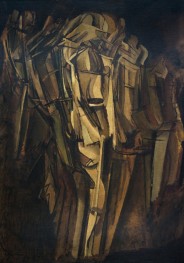
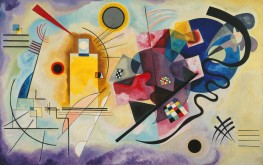


Composition with Red Head (Still Life with ... 1927
Fernand LégerOil Painting
$1500
$1500
Canvas Print
$72.90
$72.90
SKU: LEG-22707
Fernand Léger
Original Size: 146 x 113.5 cm
Kunstmuseum Basel, Switzerland
Fernand Léger
Original Size: 146 x 113.5 cm
Kunstmuseum Basel, Switzerland


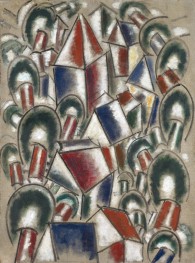

Pictorial Realism of a Peasant Woman in Two Dimensions 1915
Kazimir MalevichOil Painting
$582
$582
Canvas Print
$61.81
$61.81
SKU: KAZ-21963
Kazimir Malevich
Original Size: 40.2 x 30.1 cm
Musée des Beaux-Arts de Liège, Belgium
Kazimir Malevich
Original Size: 40.2 x 30.1 cm
Musée des Beaux-Arts de Liège, Belgium


The Nightmare of the White Elephant, from Jazz 1947
Henri MatisseOil Painting
$915
$915
Canvas Print
$61.81
$61.81
SKU: MAT-21734
Henri Matisse
Original Size: 42.1 x 65.4 cm
Art Institute of Chicago, USA
Henri Matisse
Original Size: 42.1 x 65.4 cm
Art Institute of Chicago, USA