
Bernardino Luini Painting Reproductions 1 of 1
c.1480/82-1532
Italian High Renaissance Painter
Bernardino Luini (c. 1480/82 - 1532) was a North Italian painter from Leonardo's circle. Both Luini and Giovanni Antonio Boltraffio were said to have worked with Leonardo directly; he was described to have taken "as much from Leonardo as his native roots enabled him to comprehend". Consequently many of his works were attributed to Leonardo. He was known especially for his graceful female figures with slightly squinted eyes, called Luinesque by Vladimir Nabokov.
Luini was born as Bernardino de Scapis in Runo, a frazione of Dumenza, near Lake Maggiore. Details of his life are scant.
In 1500 he moved to Milan with his father. According to Lomazzo, he trained under Giovan Stefano Scotto, although for others he was a pupil of Ambrogio Bergognone. In 1504-1507 he was probably in Treviso, as attested by a Madonna with Child signed Bernardinus Mediolanensis faciebat which is however of disputed attribution. Also from this period would be one Madonna with Child in the Christian Museum at Esztergom and Lamentation of Christ in the Fine Arts Museum of Budapest (c. 1506). His first fresco works are an Adoration of the Magi in San Pietro of Luino (c. 1505) and the attributed fresco in the presbytery of Monza Cathedral with St. Gerard of the Painters.
Luini returned in Milan in 1509, receiving a commission for a polyptych from which today remains a St. Anthony of Padua in the Museo Poldi Pezzoli, influenced by Bernardino Zenale's Cantu Polyptych. In the 1510s he painted frescoes in the Oratory of Santa Maria Nuova in Pilastrello, a Lamentation of the dead Christ in Santa Maria della Passione, a Madonna with Child in the Abbey of Chiaravalle, frescoes in San Giorgio di Palazzo (1516) and in the Certosa di Pavia, and others.
From 1509-1514 his one of Luini's best known works, the frescoes for Villa Pelucca in Sesto San Giovanni (now in the Pinacoteca di Brera, Milan), commissioned by Girolamo Rabia, for whom he also painted mythological scenes in the Palazzo Rabia (now in the Berlin Gemaldegalerie and the National Gallery of Art, Washington).
In 1521 he travelled to Rome, where he was influenced by Raphael's style. This is evident in Luini's further frescoes in the Villa La Pelucca executed in 1520-1523, as well as in other works now at Brera. From 1523 is a beautiful polyptych in the Basilica of San Magno at Legnano.
In circa 1525, he completed a series of frescoes on the life of the Virgin and Christ for the sanctuary of Santa Maria dei Miracoli in Saronno; to the same year is attributed the fresco in the counterfacade of Sant'Abbondio in Como. Other works from his middle period include a Holy Family in the Museo del Prado, two Salome in the Museum of Fine Arts in Boston and the Uffizi and a Portrait of Lady in the National Gallery of Art. From 1526 is a Virgin with Child and Saints in the Lee Fareham collection of Richmond.
In 1529 Luini completed one of his masterworks, the grand Passion and Crucifixion fresco at Santa Maria degli Angeli in Lugano, paired by other works in the same church. In 1531 he returned to the Saronno sanctuary to add other frescoes. In his later career Luini was increasingly influenced by Leonardo, as showed by the St. Anne of the Pinacoteca Ambrosiana and the St. Catherine of the Hermitage.
He died in Milan. His son Aurelio was also an accomplished painter.
Luini was born as Bernardino de Scapis in Runo, a frazione of Dumenza, near Lake Maggiore. Details of his life are scant.
In 1500 he moved to Milan with his father. According to Lomazzo, he trained under Giovan Stefano Scotto, although for others he was a pupil of Ambrogio Bergognone. In 1504-1507 he was probably in Treviso, as attested by a Madonna with Child signed Bernardinus Mediolanensis faciebat which is however of disputed attribution. Also from this period would be one Madonna with Child in the Christian Museum at Esztergom and Lamentation of Christ in the Fine Arts Museum of Budapest (c. 1506). His first fresco works are an Adoration of the Magi in San Pietro of Luino (c. 1505) and the attributed fresco in the presbytery of Monza Cathedral with St. Gerard of the Painters.
Luini returned in Milan in 1509, receiving a commission for a polyptych from which today remains a St. Anthony of Padua in the Museo Poldi Pezzoli, influenced by Bernardino Zenale's Cantu Polyptych. In the 1510s he painted frescoes in the Oratory of Santa Maria Nuova in Pilastrello, a Lamentation of the dead Christ in Santa Maria della Passione, a Madonna with Child in the Abbey of Chiaravalle, frescoes in San Giorgio di Palazzo (1516) and in the Certosa di Pavia, and others.
From 1509-1514 his one of Luini's best known works, the frescoes for Villa Pelucca in Sesto San Giovanni (now in the Pinacoteca di Brera, Milan), commissioned by Girolamo Rabia, for whom he also painted mythological scenes in the Palazzo Rabia (now in the Berlin Gemaldegalerie and the National Gallery of Art, Washington).
In 1521 he travelled to Rome, where he was influenced by Raphael's style. This is evident in Luini's further frescoes in the Villa La Pelucca executed in 1520-1523, as well as in other works now at Brera. From 1523 is a beautiful polyptych in the Basilica of San Magno at Legnano.
In circa 1525, he completed a series of frescoes on the life of the Virgin and Christ for the sanctuary of Santa Maria dei Miracoli in Saronno; to the same year is attributed the fresco in the counterfacade of Sant'Abbondio in Como. Other works from his middle period include a Holy Family in the Museo del Prado, two Salome in the Museum of Fine Arts in Boston and the Uffizi and a Portrait of Lady in the National Gallery of Art. From 1526 is a Virgin with Child and Saints in the Lee Fareham collection of Richmond.
In 1529 Luini completed one of his masterworks, the grand Passion and Crucifixion fresco at Santa Maria degli Angeli in Lugano, paired by other works in the same church. In 1531 he returned to the Saronno sanctuary to add other frescoes. In his later career Luini was increasingly influenced by Leonardo, as showed by the St. Anne of the Pinacoteca Ambrosiana and the St. Catherine of the Hermitage.
He died in Milan. His son Aurelio was also an accomplished painter.
1 Bernardino Luini Paintings
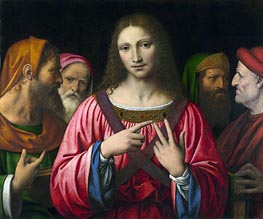
Christ among the Doctors c.1515/30
Oil Painting
$3703
$3703
Canvas Print
$80.52
$80.52
SKU: LUI-8446
Bernardino Luini
Original Size: 72.4 x 85.7 cm
National Gallery, London, UK
Bernardino Luini
Original Size: 72.4 x 85.7 cm
National Gallery, London, UK