
Renaissance Artists Index
Alphabetical Index of the Great Masters of Renaissance
The Renaissance was a cultural and artistic movement that flourished in Italy during the fifteenth and sixteenth centuries, combining classical ideals with close observation of nature. Its roots reached into the previous century, particularly the bodily weight and emotional directness of Giotto's figures. Humanist study of ancient literature encouraged mythological subjects alongside religious painting. Churches, civic authorities, and prosperous families commissioned altarpieces, fresco cycles, and portraits that expressed devotion, political authority, or social standing.
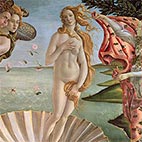
In fifteenth-century Florence, Early Renaissance painters made pictorial space more measurable. Masaccio gave bodies firm volume and placed them within coherent architectural settings. Piero della Francesca used geometry and restrained gestures to create figures of unusual stillness. Botticelli pursued a different beauty through finely drawn contours, rippling hair, and fluttering draperies. His figures often seem suspended in movement rather than firmly planted on the ground. Fresco served large wall cycles, while tempera on wooden panels encouraged precise edges and small, controlled touches.
The High Renaissance emerged around 1490 and flourished during the opening decades of the sixteenth century. Leonardo da Vinci, Raphael, and Michelangelo coordinated figures, setting, and narrative within unified compositions. Groups often form pyramids or gather around a clear center. Glances and gestures connect people across the picture, while light models rounded bodies. Madonnas frequently convey composure through balanced poses and closely linked figures. Large narrative scenes accommodate vigorous movement without sacrificing the legibility of the whole.
Leonardo's The Last Supper (1495-1498) remains in the refectory of Santa Maria delle Grazie in Milan. Christ's announcement of betrayal sets the apostles' hands and faces into motion. Four groups of three register different reactions around his isolated figure. The painted room's receding lines direct attention toward him. Leonardo worked on a dry wall, allowing slower revisions than traditional fresco, but his experimental paint layer deteriorated early. In his panel paintings, sfumato softens contours through barely perceptible transitions between light and shade.
Raphael painted The School of Athens (1509-1511) in Pope Julius II's apartments in the Vatican. Ancient philosophers gather beneath immense vaults, with Plato and Aristotle at the center. Plato points upward; Aristotle extends his hand with the palm facing down. Around them, groups read, debate, and demonstrate. Steps and intervals between figures keep this crowded assembly intelligible. The fresco belonged to a decorative program that placed philosophy alongside theology, poetry, and law, giving classical learning a prominent place within the papal residence.
Julius II also commissioned Michelangelo's Sistine Chapel ceiling (1508-1512), still in its original setting in the Vatican. Scenes from Genesis occupy the central field, surrounded by prophets, sibyls, and muscular nude youths. Michelangelo gave painted bodies a sculptural force through articulated limbs, turning torsos, and pronounced foreshortening. Bright colors distinguish neighboring figures and draperies. Physical action carries much of the narrative's emotional force: even seated figures twist or lean as though preparing for movement.
Venice developed a distinct emphasis on color and atmosphere through Giorgione and Titian. Giorgione made landscape an active part of a scene's mood. Oil paint allowed translucent layers, luminous flesh, and richly modulated fabrics. In Titian's Assumption of the Virgin (1516-1518), red garments connect the apostles below with Mary above. Raised arms and tilted heads direct movement through three levels toward a golden heaven. The painting remains above the high altar of Santa Maria Gloriosa dei Frari in Venice, where its scale answers the church's monumental interior.
Leonardo died in 1519 and Raphael in 1520. The sack of Rome in 1527 disrupted the city's workshops and patronage. Painters such as Pontormo and Parmigianino developed elongated figures, difficult poses, and unstable spatial relationships in the emerging Mannerist style. Venetian painting followed a different timetable. Titian continued working for decades, increasingly constructing forms through loose, broken brushstrokes, while the balanced compositions of the High Renaissance remained influential models.
In fifteenth-century Florence, Early Renaissance painters made pictorial space more measurable. Masaccio gave bodies firm volume and placed them within coherent architectural settings. Piero della Francesca used geometry and restrained gestures to create figures of unusual stillness. Botticelli pursued a different beauty through finely drawn contours, rippling hair, and fluttering draperies. His figures often seem suspended in movement rather than firmly planted on the ground. Fresco served large wall cycles, while tempera on wooden panels encouraged precise edges and small, controlled touches.
The High Renaissance emerged around 1490 and flourished during the opening decades of the sixteenth century. Leonardo da Vinci, Raphael, and Michelangelo coordinated figures, setting, and narrative within unified compositions. Groups often form pyramids or gather around a clear center. Glances and gestures connect people across the picture, while light models rounded bodies. Madonnas frequently convey composure through balanced poses and closely linked figures. Large narrative scenes accommodate vigorous movement without sacrificing the legibility of the whole.
Leonardo's The Last Supper (1495-1498) remains in the refectory of Santa Maria delle Grazie in Milan. Christ's announcement of betrayal sets the apostles' hands and faces into motion. Four groups of three register different reactions around his isolated figure. The painted room's receding lines direct attention toward him. Leonardo worked on a dry wall, allowing slower revisions than traditional fresco, but his experimental paint layer deteriorated early. In his panel paintings, sfumato softens contours through barely perceptible transitions between light and shade.
Raphael painted The School of Athens (1509-1511) in Pope Julius II's apartments in the Vatican. Ancient philosophers gather beneath immense vaults, with Plato and Aristotle at the center. Plato points upward; Aristotle extends his hand with the palm facing down. Around them, groups read, debate, and demonstrate. Steps and intervals between figures keep this crowded assembly intelligible. The fresco belonged to a decorative program that placed philosophy alongside theology, poetry, and law, giving classical learning a prominent place within the papal residence.
Julius II also commissioned Michelangelo's Sistine Chapel ceiling (1508-1512), still in its original setting in the Vatican. Scenes from Genesis occupy the central field, surrounded by prophets, sibyls, and muscular nude youths. Michelangelo gave painted bodies a sculptural force through articulated limbs, turning torsos, and pronounced foreshortening. Bright colors distinguish neighboring figures and draperies. Physical action carries much of the narrative's emotional force: even seated figures twist or lean as though preparing for movement.
Venice developed a distinct emphasis on color and atmosphere through Giorgione and Titian. Giorgione made landscape an active part of a scene's mood. Oil paint allowed translucent layers, luminous flesh, and richly modulated fabrics. In Titian's Assumption of the Virgin (1516-1518), red garments connect the apostles below with Mary above. Raised arms and tilted heads direct movement through three levels toward a golden heaven. The painting remains above the high altar of Santa Maria Gloriosa dei Frari in Venice, where its scale answers the church's monumental interior.
Leonardo died in 1519 and Raphael in 1520. The sack of Rome in 1527 disrupted the city's workshops and patronage. Painters such as Pontormo and Parmigianino developed elongated figures, difficult poses, and unstable spatial relationships in the emerging Mannerist style. Venetian painting followed a different timetable. Titian continued working for decades, increasingly constructing forms through loose, broken brushstrokes, while the balanced compositions of the High Renaissance remained influential models.