
Secession, Symbolism & Art Deco Artists Index
Alphabetical Index of the Great Masters of Secession, Symbolism & Art Deco
The Vienna Secession, Symbolism, and Art Deco brought distinct approaches to European painting between the late nineteenth century and the interwar years, connected by an interest in stylization and expressive form. Gustav Klimt occupied a particularly important position within this history. His paintings joined the imaginative concerns of Symbolism to an increasingly independent organization of color, line, and ornament. Later Art Deco painters developed their own relationships between the figure and the painted surface, responding to a different social world. Across these overlapping developments, portraiture, allegory, and the representation of desire acquired new visual possibilities.
Symbolist painting developed across Europe during the later nineteenth century around subjects drawn from mythology, religion, dreams, and private imagination. Gustave Moreau filled his compositions with densely elaborated figures and objects whose significance often remained elusive. Odilon Redon gave color and form an evocative freedom, allowing flowers, faces, and fantastic beings to inhabit uncertain spaces. Fernand Khnopff cultivated an atmosphere of stillness and emotional distance. Their methods varied considerably, but each treated the image as a means of suggesting experiences that could not be fully explained through a description of visible events.
Arnold Böcklin’s “Isle of the Dead” offered a particularly influential example of this suggestive approach. In the 1883 version in Berlin’s Alte Nationalgalerie, a small boat approaches an island enclosed by pale rock and dark cypresses. A white figure stands beside a coffin, establishing a human presence within the immense stillness. The arrangement slows the eye: the narrow approach, vertical trees, and unbroken water make arrival feel prolonged. The painting gives recognizable form to an encounter with mortality while leaving its circumstances unresolved. Its emotional force depends on the sustained relationship between silence, distance, and expectation.
The Vienna Secession was founded in 1897 by artists who withdrew from the Künstlerhaus and sought greater independence in exhibiting their work. Klimt became its first president; painters including Carl Moll, Koloman Moser, and Max Kurzweil contributed to its early identity. International exhibitions widened contact with contemporary European painting and challenged the limits of established Viennese taste. The association accommodated different artistic methods, while its connections with Art Nouveau encouraged an emphasis on contour and patterned surfaces. For Klimt, this setting provided a public platform for paintings in which the human figure increasingly carried symbolic and psychological meanings.
Klimt’s academic training remained evident in his command of anatomy and the careful modeling of faces and hands. He placed these passages within compositions that compressed space and transformed clothing or background into broad ornamental fields. His paintings of Philosophy, Medicine, and Jurisprudence for the University of Vienna provoked fierce controversy through their treatment of the body, suffering, and human vulnerability. The dispute exposed the distance between official expectations and his increasingly personal conception of allegory. He subsequently withdrew from government commissions, developing his work through independent painting and the support of private patrons.
“Judith I” (1901), in the Belvedere collection, Vienna, concentrates his Symbolist approach within a narrow vertical format. Judith’s partly closed eyes, raised chin, and exposed flesh hold the viewer’s attention, while the severed head of Holofernes remains partly concealed at the lower edge. Gold and repeated motifs intensify the figure’s commanding presence. Klimt shifted the emphasis of the biblical subject toward the uneasy relationship between attraction, power, and violence. Her expression resists a single emotional reading, giving the painting an ambiguity that persists even when the narrative is familiar.
In “Portrait of Adele Bloch-Bauer I” (1907), at the Neue Galerie, New York, oil paint, gold, and silver create a surface of unusual material complexity. Adele’s face and clasped hands emerge from a network of triangles, spirals, and repeated eye motifs. Her dress and surrounding space appear to merge, making the boundary of the body difficult to follow. Klimt’s encounter with Byzantine imagery in Ravenna in 1903 helped nourish this interest in luminous surfaces and frontal presence. The portrait combines the individuality of a contemporary sitter with a degree of ceremonial abstraction, allowing bodily fragility and social distinction to coexist.
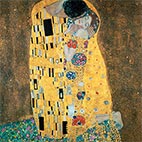
“The Kiss,” dated approximately 1907-1909 and belonging to the Belvedere, brings two figures together within a square canvas dominated by gold. Rectangular patterns on the man’s garment meet the rounded, floral forms surrounding the woman. The small areas of exposed skin give the embrace its physical immediacy, while the enveloping ornament binds the couple into a larger shape. Their position at the edge of a flowered bank introduces a slight instability into the apparent repose. Shown at the Kunstschau in 1908, the painting belonged to Klimt’s mature work after his departure from the Secession in 1905.
His landscape painting extended these investigations through different subjects. During summers around the Attersee, Klimt painted gardens, orchards, woodland, and water, frequently adopting a square format and a high horizon. Small touches and repeated shapes could turn foliage into a dense field that still retained the specificity of a place. The eye moves between individual leaves or blossoms and the larger arrangement of color. These paintings reveal how deeply his interest in ornament depended on observation. Pattern could emerge from the patient organization of natural forms, giving landscape a concentrated, almost enclosed pictorial rhythm.
Art Deco painting developed most prominently during the 1920s and 1930s, with Paris as a major center. The international exhibition held there in 1925 became a defining historical reference for the style. Painters associated with it brought classical figure traditions into contact with geometric simplification and aspects of Cubism. Clearly bounded shapes, controlled modeling, and emphatic color relationships gave portraits and allegorical subjects a heightened visual clarity. The social setting had also changed: images of elegance, mobility, celebrity, and personal independence became important ways of representing modern identity.
Tamara de Lempicka gave these concerns a distinctive pictorial form. Working in Paris, she developed figures whose strongly modeled volumes sit within tightly organized compositions. In “Young Woman in Green,” also known as “Young Lady with Gloves” (1927-1930), in the Centre Pompidou collection, the green dress is articulated through sharp folds and broad highlights. Cloth acquires an almost sculptural weight, while the smooth handling suppresses the visibility of separate brushstrokes. The face, gloved hand, and sweeping fabric create a calculated sequence of accents. Fashion becomes part of the painting’s formal structure and of the figure’s deliberate presentation to the viewer.
Her “Self-Portrait in the Green Bugatti” (1929) makes that presentation especially explicit. Lempicka depicts herself at the wheel, bringing the face, driving glove, and car into a compressed arrangement. Firm edges and metallic colors give the image a precise, controlled energy. The tight cropping creates a sense of proximity, while her composed expression suggests command over the surrounding space. As a self-portrait, the painting also allowed the artist to shape her public identity. Modernity appears through a cultivated combination of independence, luxury, and self-possession.
Jean Dupas represented another important direction within Art Deco painting. His elongated figures and carefully repeated gestures drew on Renaissance and Mannerist precedents while incorporating a modern taste for geometric organization. “Les Perruches” (1925), shown at the Paris exhibition that year, brought idealized figures and birds into an elaborate pictorial arrangement. The clarity of the contours and the measured distribution of forms give the composition its authority. Dupas retained the imaginative possibilities of allegorical painting within a highly ordered visual language. His work demonstrates how the ideal figure could remain central to modern painting, its meaning shaped through proportion, rhythm, and the relationships between colors.